
Iwate has grown together with horses.
In the Nara period, this land was known as Nukanobu, a horse-producing region renowned even at the imperial court. The horses of Nukanobu were prized as the finest of steeds, admired by the people of the capital.
In the early Kamakura period, Minamoto no Yoritomo sent Nanbu Mitsuyuki, a master of horse breeding, from Kai to this land. Through generations of crossbreeding with Kai horses, the large and hardy “Nanbu horse” was born. Here, building the region went hand in hand with raising horses.
In the Edo period, as an age without war arrived, horses moved from the battlefield to the fields. The Nanbu Nine Pastures were established, and horses supported daily life as farm animals. The “Nanbu magariya,” the L-shaped farmhouse where people and horses lived under one roof, still tells us today how closely this land has lived with the horse.
In the Meiji era, the Percheron—a heavy draft breed from Normandy, France—was introduced. The blood of this powerful yet gentle horse was passed down to the very horses that would become the stars of Chagu-Chagu-Umacco.
And the exchange between Iwate and France continues today. Sanbarikisha maintains a technical exchange with Haras du Pin, the national stud in Normandy—founded in 1715 and sometimes called “the Versailles of horses,” set in the heartland of the Percheron. About twice a year, we invite instructors or visit in person.
The wisdom of working with horses is a safety net for humanity.
Society can change dramatically
Fossil fuels, the power grid, and supply chains that cross borders—our lives today rest on the assumption that these never stop. But society can change dramatically. Disaster, resource depletion, a severed supply chain. The more a system is optimized for efficiency, the greater the cost when change comes.
Europe and North America have long been taking action
Horse logging and horse plowing are often remembered in Japan as “old ways.” Yet in the United Kingdom and the United States, associations dedicated to horse logging exist, and the work of horses and people together is still chosen on real job sites today. A horse senses the terrain and the moment, moving in step with its handler. It is precisely because of that relationship—something no machine can offer—that work is possible on slopes machines cannot reach, without scarring the ground. This is not nostalgia; it is a choice grounded in trust for the horse as a living being.
Here in Japan, only a handful remain
In Japan, meanwhile, those who still carry on the craft of horse logging are said to number only a few nationwide. Most are elderly. Iwate is one of the few regions where the craft still survives.
Preserving those who know what to do
We believe this is a safety net for humanity. When the shape of society changes, after the single-minded pursuit of efficiency, what will remain? To keep, in this land, people who hold the answer—that is our work.
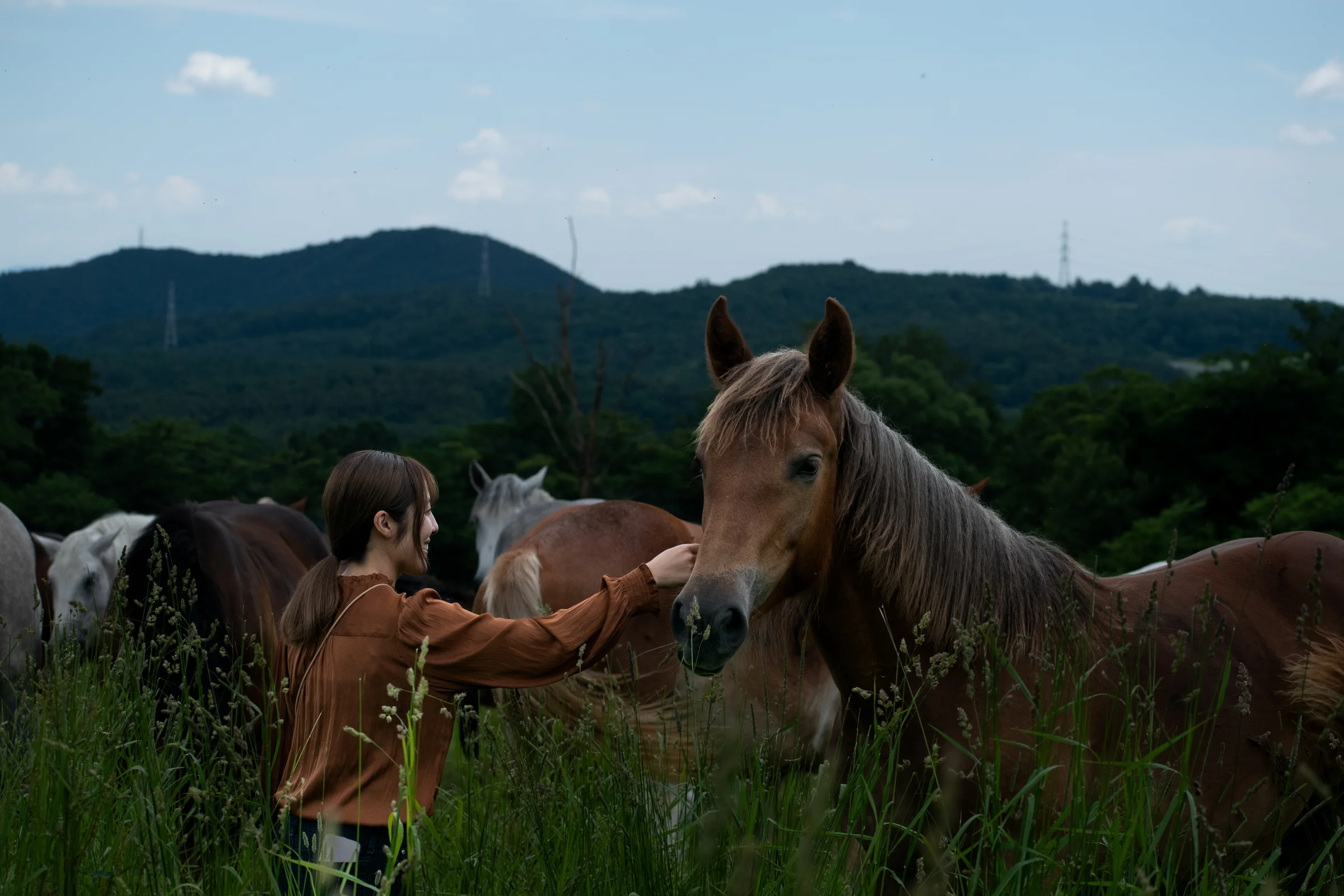
We stand on that same line.
From the steeds of Nukanobu, to life in the Nanbu magariya, to the heavy horse that came from France—Iwate has always answered the needs of its age together with the horse. We stand at the far end of that same line.
Even if a day comes when efficiency alone no longer holds, this land has people, horses, and tools to rely on. That is no accident: it remains only because we keep choosing it, again and again.
We have distilled our thinking into three words.
Keeping horse culture a living option for the future.
When efficiency alone is no longer enough,
there remain people, horses, and tools to rely upon.
- People, horses, and tools as one
- Practice, not nostalgia
- Recognizing value beyond rationality
Come and see our horses at work.
We welcome inquiries for filming, visits, and press.